Director, MK Surveys
Lewis Hook BSc (Hons) MCInstCES MRICS,


Started with: BSc in Surveying and Mapping, Newcastle University
Working as: Surveyor, Atlantic Geomatics
What does a Land Surveyor do?
A Land Surveyor measures and maps land to determine its size, boundaries and characteristics for projects within construction and property development. They use technology such as GPS, total stations, and scanning technology to collect and analyse data, creating detailed maps and site plans for architects, engineers, and other professionals. Their work involves both fieldwork to gather measurements, and office work to process and analyse data and then produce reports.
What does your typical day look like?
A typical day in the week of my life usually involves 3 or 4 days on site or in the field, collecting monitoring data on a variety of structures around the North of England, followed by the remainder processing this data to form charts and spreadsheets that highlight any movement that may have taken place between surveys.
How did you get into surveying?
A combination of reasons and good fortune. I have always been interested in engineering, with both my dad and grandad being geotechnical engineers. I enjoyed geography at school and was hoping to study it at university, but I had second thoughts before enrolling when contemplating what kind employment in the future and direction in my life this may lead. A brief conversation with a university enrolment officer identified the possibility of a degree in Surveying and Mapping at Newcastle University and I jumped at it.
I enjoyed my studies at Newcastle (Surveying and Mapping BSc), made a great bunch of friends while studying who are still my best mates to date. I was lucky that on the small course of 19 of us, we all got along well and helped each other along and socialised regularly, which isn’t always the case, so I count myself fortunate.
We were all keen to use our achieved degrees immediately by taking on survey roles as a land surveyors at various businesses around the UK, which was great to follow each other’s examples, especially when friends who had studied other degrees often felt left behind or rather uninspired post-graduation.
It certainly helped me in my career as it was often complex and tough to learn as a new skill, problem solving skills I now seemingly get regularly on a weekly basis on projects. Contact hours were high with regular practical sessions, so I definitely got value for money.
How had your career developed?
I started working for Atlantic Geomatics in 2019 as a trainee surveyor. Straight away I found myself thrown onto sitework with a variety of projects and shadowing highly experienced surveyors. It was a small business who at the time only had 7 site staff including myself. I bonded well with everyone quickly after moving to a new area of the country where I didn’t know anyone. I enjoyed the responsibility I had been trusted with from an early stage and learned site methods quickly, so that after 8 months I was already capable of completing tasks on site by myself. I felt rewarded when I could see the results of my surveys in the end maps, traverse results and graphs, which is an aspect of surveying that I really value.
After two years as a trainee, in 2021 I became a Surveyor, after managing projects successfully for good periods of time. I was certainly helped by always having incredibly knowledgeable surveyors above me where any questions I could go to them with.
Work at Atlantic Geomatics is incredibly varied, with regular projects in topographic, cadastral, Bathymetric, Utility and Monitoring surveys. This variety has helped me learn a vast range of skills and I love that no day in my life is ever the same. Everyone works as a team to make sure we produce the best surveys for clients while remaining safe and looking out for each other.
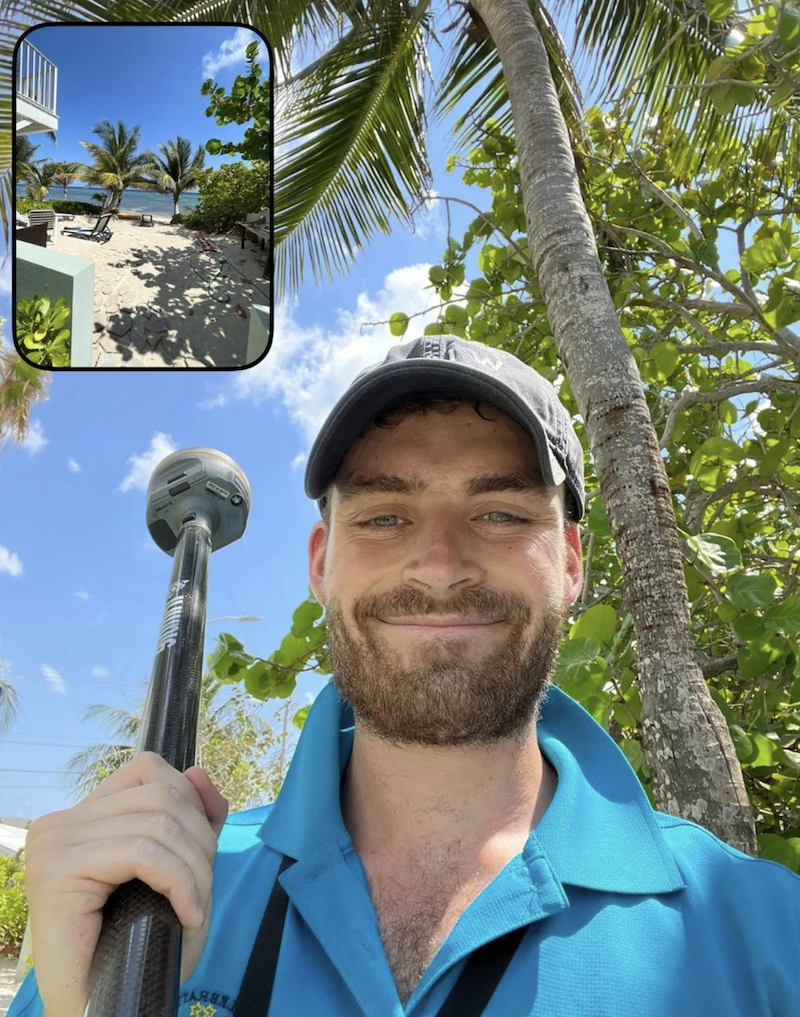
In 2023 I briefly left Atlantic for another challenge. Living abroad is something I’ve always wanted to do, and I felt I wanted to prove myself in different landscapes and environments. So when a role of a land survey officer at Cayman Islands Government appeared I took it without hesitation.
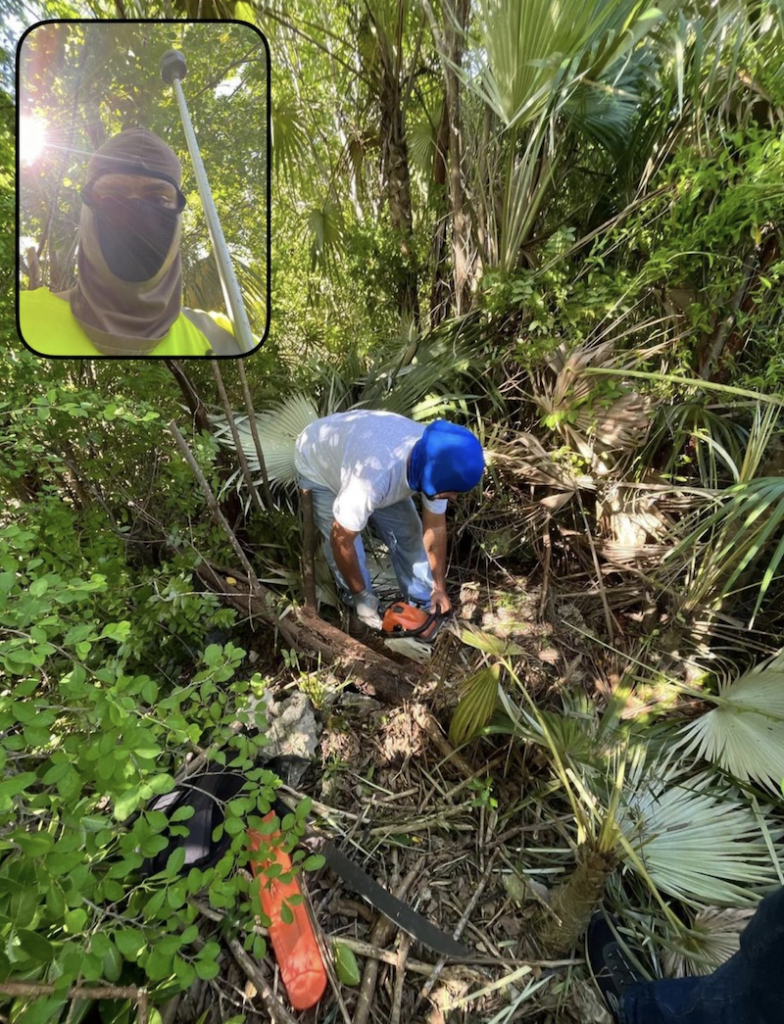
This was an incredible time where I put into practice the skills I had learned at Atlantic in a very different landscape. Most of Grand Cayman is undeveloped swamp and low lying jungle with cacti and difficult wildlife (as well as unbelievable beaches and billionaire villas). Surveys were suddenly very difficult in extreme heat (often +40C). Equipment was considerably older, where the manual total station was my best friend in traversing through thick jungle.
Life was hard on the island, and the government survey department had a very limited budget. Myself and the survey team I was in charge of grew close while working in some extremely tricky environments. I certainly toughened up as a result of my year there and grew confidence in myself in tough circumstances and challenges I had faced.
The following year I returned to Atlantic with a new sense of determination. New team members had joined and by the end of 2025 we have over 13 site staff. I have worked closely with school leavers during this time and helped train them into capable site surveyors. I enjoy teaching people how to survey and basic techniques. I love learning new skills so hopefully they might teach me something new in return one day. I’m not sure what the future holds but it’s very exciting being at a growing business that has big ambitions. I’m only 28 so I would like to think I’ve got quite a lot of experiences to come.
What do you enjoy and value most in your job?
In my current role I undertake a variety of surveys, but mostly topographic and monitoring based projects. I often work with one or two junior members in conducting these surveys and make sure all work is completed safely. I love that no day is ever the same and there is always a new challenge to solve.
What is the most challenging aspect of your job?
Challenges vary from project to project. Whether its high risk confined space projects where I am the designated rescuer (obviously I hope I am never needed to be called into action but this requires total concentration and preparation at the time), or being the senior member of a team where a tricky operation may be taking place such as lifting a heavy manhole cover. I certainly think High-Risk confined space operations within surveys are the most challenging jobs we take on due to the level of preparation and checks that must take place before any work can commence.
How do you encourage younger people to consider surveying as a career?
I took the university route. Having seen younger surveyors at Atlantic take the apprentice route, I’m a little jealous as I’m paying off my student loans – maybe this route is more appealing for today’s generation. Certainly, I’d suggest to anyone who loves the outdoors to give it a go. You only really know if you can hack working outside regularly until you do it and there’s no shame in not enjoying it. Best bet is contact your local survey company for a weeks trial.
If you could give your younger self career advice now, what would it be?
I’d like to think I’m still young, so I’m comfortable making mistakes and owning them as long as I try and learn from them. I’d probably tell myself to watch the weather forecast every night before a day on site, but I still often forget and rue not packing extra layers. I don’t have any big regrets so I guess I’m happy with how things have gone.
What skills does someone need to do your job?
A good work ethic is probably the best trait, like any career, but certainly in surveying as that extra time and care can go an awfully long way. The ability to step back and consider one’s surroundings is certainly important to keep everyone safe. Being a good team player is very important. If you get along with everyone it starts to feel less like a job and more like a hobby when things are going well.
Obviously to go on to being a surveyor, having the experience to identify important features on each site that should be analyzed or mapped, understanding what a client wants, potential hazards – are all things that are required.
What has been your most memorable project to work on?
The most memorable project I have worked on was a monitoring project where I had to collect data from 150+ reservoirs in the north west of England. Lots of travelling and amazing scenery. Worked with some great younger surveyors who assisted. All the results were what we all wanted which helped!
What has been your proudest career moment?
My proudest moment was completing a survey I undertook of a small plot of land deep within the jungle in Grand Cayman. I had a survey team with very little knowledge so I had my reservations prior, but we produced an excellent traverse and then topographic survey at the end. Days of cutting sight lines through the jungle and avoiding the massive land crabs. 46 Celcius heat. Humidity at nearly 100%. UV at level 13. When we finished after three weeks, we all went for some well-deserved drinks. I’ve never felt relief like it.