FAQs
Frequently asked questions
Let’s answer some of your questions…
Surveyors make very detailed maps of specific areas of land so that buildings, roads, and bridges can be constructed in the right place. They make sure a bridge meets in the middle if it’s built from each end, for example, and they have to work to millimetre accuracy. And they survey rivers to work out how much water they can manage to help prevent flooding. Surveyors are an essential part of making sure the construction is carried out accurately.
Surveying is a great career if you like being outdoors and using technology to look at data. Your time is split between being outside surveying areas, and then back in the office using computer programmes to produce the plans and models. You could be surveying anywhere in the world – up mountains, on rivers, or on construction sites!
You might think that with modern survey equipment, you don’t need to concentrate as much or pay as much attention to detail when creating a survey. But even though that equipment makes the collection of data much quicker, surveying skills like accuracy and attention to detail date back thousands of years – they’re absolutely critical and as important as ever.
It’s incredible to think that the Pyramids and our cathedrals were built hundreds of years ago, and yet, they ended up in exactly the right position and fit together perfectly, without modern electronic equipment! Surveyors in the past used their skills in measuring and positioning to make sure things were built correctly. Modern-day surveyors still need to do the same; they just have much more equipment to help them.
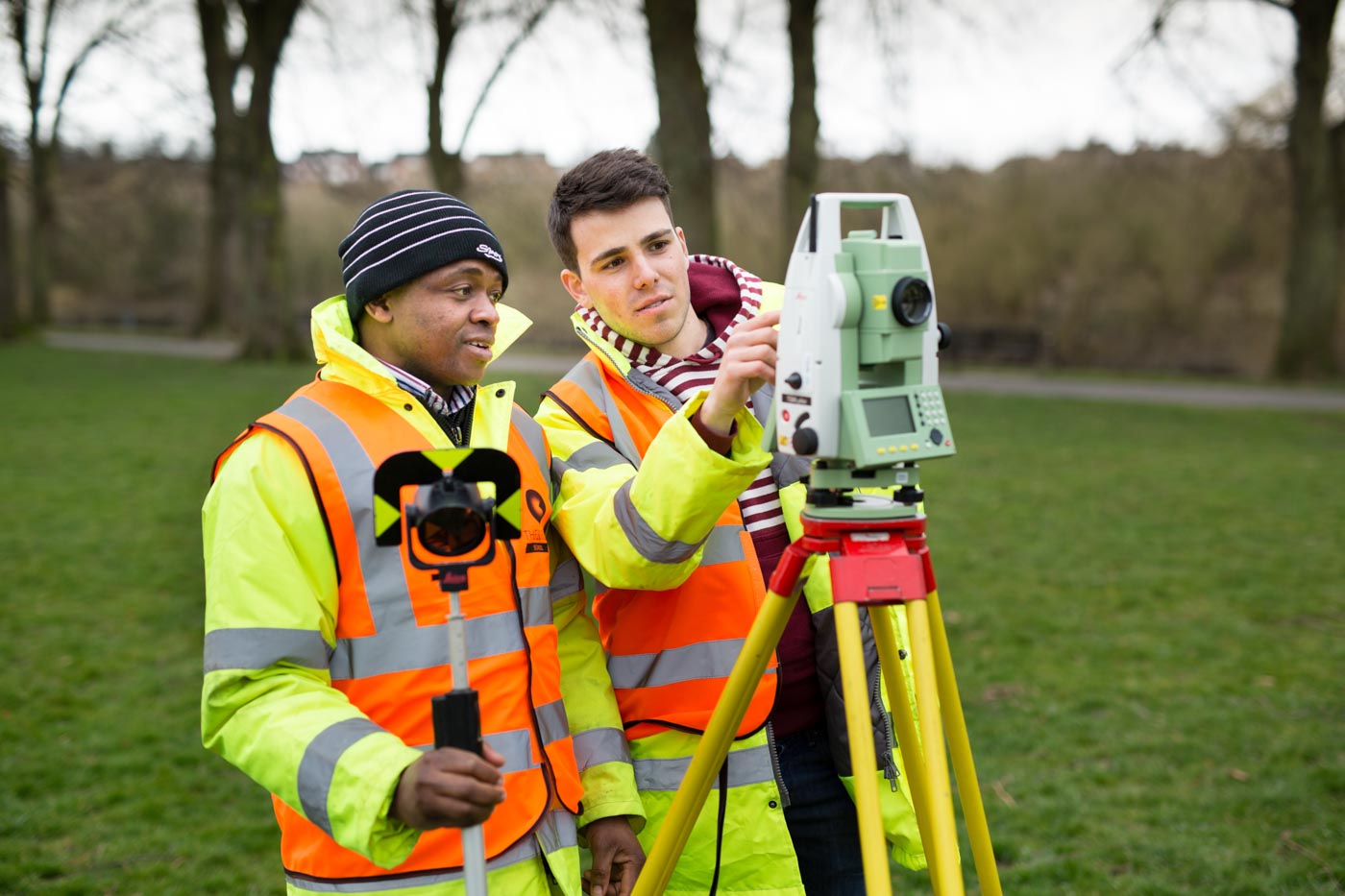
In surveying, there’s a lot of specialist technology that we use to collect data about the position of something. We use equipment like drones, GPS trackers, and total stations to measure the features of an area, like fence lines, manholes, and overhead wires. A total station is made up of a telescope, computer, and reflector. It helps you to see the horizontal and vertical angles, as well as the distances, between two different points.
Then, we make a drawing, or map, of those features at a scale of 1:200. And finally, we use the drawings to produce models of the areas, using software like AutoCAD and Revit.
So, like in lots of jobs, the technology for surveying is always progressing. We now use equipment that can be carried on vehicles or on drones, and robot dogs that can go into areas that people might not want to! And there are things like laser scanners, which can pick up accurate data quickly, and send it through to the processing computers to be made into 3D models.
Problem solving is one really important skill. You might come across problems that stump you – like a bridge that you haven’t seen before. If you’ve seen someone survey something like it, you could get them to help you. Knowing how it needs to look in the office will help you figure it out – you’ll need to picture it in your head.
You’ll be trying to figure out how to spot errors, learning as you go, and using previous experience (like figuring out depth levels) over time.
Teamwork is another key skill. Surveyors normally work in pairs, so you have to be comfortable with taking shared responsibility. You’ll need to organise your own schedule, with others, and communicate where you’ve been and what you’ve done.
And finally, attention to detail matters. If you miss something, you have to go back to the place literally to measure it again, or write an apologetic email and start again!
You need to be happy to work outside if you want to be a surveyor! A good way to find that out is to try a hobby that’s outdoors, even if that’s just going for walks in nature. It might help you feel less doubtful about being in all the different weather conditions if you’ve already experienced them, and you know they don’t bother you.
Geography and maths are the most useful subjects you can study at school or college. It’s helpful to be familiar with maps and angles.
IT is another useful one. If you can try some computer programming, using languages like C++ or Python, you’ll feel more confident when it comes to processing data and creating 3D models.